

The Future of Marketing: How Digital Marketing is Changing the Game
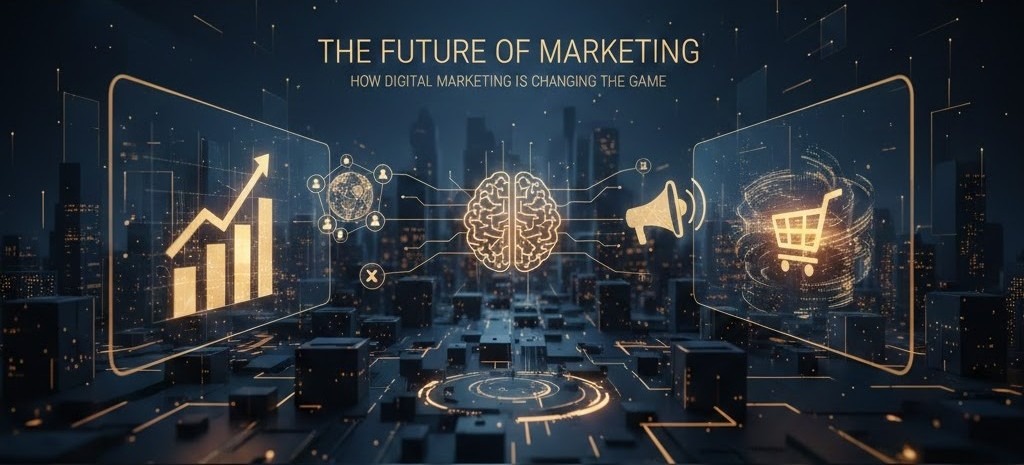
Digital marketing has not only been the extension of traditional advertising but it has now taken the center stage in terms of how companies grow, compete, and create long term relationships with their clientele. With consumers becoming increasingly digitally oriented in their exploration, purchase and interaction with a brand, companies are being pushed to get smarter, more attentive and more personal in their marketing.
Digital marketing is transforming the customer experience in all customer cycle stages such as artificial intelligence and automation, data analytics, and omnichannel experiences. The future of marketing is to find out the extent to which marketing can utilize technology and still deliver a more human experience more naturally.
Key Takeaways:
● The digital-first and customer-centred models are driving the future of marketing.
● Artificial intelligence and automation are redefining how campaigns will be executed and optimized.
● Now, there is the need to learn consumer behavior using data and analytics.
● The omnichannel experiences are becoming the standard of brand experience.
● In marketing, technology, along with the element of creativity, is becoming a success factor.
To see what the marketing is leading towards this intersection point, it is crucially important to look into how the industry has transformed the traditional models to the present-day digital ecosystem.
The Evolution of Marketing in the Digital Era
The process of marketing is no longer as mass communication-focused but very much focused and data-driven. Traditional strategies are aimed at meeting huge goals, but digital marketing is aimed at precision, personalisation and measurability. This shift has transformed how the brands attract, identify and maintain the customer.
Traditional Marketing vs Digital Marketing
|
Factor |
Traditional Marketing |
Digital Marketing |
|
Communication Style |
One-way messaging |
Two-way interaction |
|
Audience Targeting |
Broad and generic |
Highly targeted and segmented |
|
Performance Tracking |
Limited measurement |
Real-time analytics |
|
Cost Efficiency |
High cost |
Budget-friendly and scalable |
|
Customer Engagement |
Passive consumption |
Active engagement |
|
Personalization |
Minimal |
Advanced personalization |
|
Adaptability |
Slow to change |
Instant optimization |
The Use of Artificial Intelligence in Online Marketing
Artificial intelligence usage has become one of the most powerful factors that determine modern digital marketing. AI may also allow marketers to offer smarter, faster, and more personalized experiences to customers, processing a significant amount of data in real time. Nevertheless, companies are not using intuition to make the best decisions regarding campaigns, predictive behavior, and automation of complex processes anymore but use the insights of AI.
AI-Powered Personalization
AI allows customizing websites, emails, and advertisements on the fly. Through artificial intelligence, the browsing patterns are analyzed and automatically the user receives content according to their preference.
Marketing Automation
Monotonous activities like email marketing, lead scoring, customer segmentation and social marketing would also be automated by robots. This helps to increase efficiency and uniformity.
Predictive Analytics
AI assists marketers to predict, find valuable customers, and churn. This allows it to formulate its strategy proactively instead of taking a reactive approach.
Virtual Assistants and Chatbots.
AI chatbots guarantee 24/7 customer service, immediate response to queries, and customer navigation along the sales funnel, which significantly improves interactions and sales.
Dynamism of Data Marketing and Consumer-based Behavior
The biggest resource in online marketing is information. Every online interaction by clicking, searching, liking and purchasing leaves behind the information which can be processed to obtain an insight into customer behaviour. Data-driven marketing helps companies to divide audiences, find high-value groups, and run campaigns in real time. The digital platform offers certain analytics on impressions, engagement, conversions, and the return on investment, unlike the traditional marketing which is difficult to measure. The future marketing requires knowledge of the consumer behavior. The current day clients desire to have smooth and personal experiences on the devices and platforms. They research products available on the internet, reviews, compare prices, and communicate with the brands on social media before making a purchase.
Responsible use of customer data can help the business to predict customer needs, provide relevant content and establish long-term customer loyalty. Nevertheless, privacy of data and legal compliance, such as the GDPR regulations and others, are also a necessity. Trustworthy brands in the digital world will be defined by honesty and proper use of data.
Customer Experience and the Omnichannel Marketing
Companies do not consider the different channels as individual entities but rather they make the channels similar in every platform.
Contemporary marketing is based on experience with customers. Over the contemporary consumer is the requirement of the high-loading websites, easy-to-use interface, trusted customer service, and personalized suggestions. Failing to have a successful experience in one channel will have a negative influence on the overall perception of the brand.
Making the channel coordinate seamlessly is made possible by digital marketing tools such as customer relationship management (CRM) systems, marketing automation applications and dashboards. As an example, a shopping cart may remind a user either through a custom email or a specific social media ad in case they leave it behind.
Companies with customer experience as their priority will be more successful in the future than their competitors. Marketing will no longer be about selling, but it will be about value provision at each point of contact.
The Future of the Digital Marketing Strategy and Skills
Marketing, as we know it will require new strategies and competencies in future. As the technologies change, the marketers must follow the trends of voice search, video advertising, augmented reality (AR), and immersive content.
One of the digital marketing strategies that are becoming highly sophisticated is search engine optimization (SEO). Search engines are also putting more emphasis on user intent, content quality and experience than on keywords. Marketers ought to work on creating authoritative, informational, and interesting content that satisfies the needs of the users.
Social media has been evolving as a robust marketing media. The sphere of influence marketing, short video, and content that includes an element of community is growing. Relevant brands must be authentic, participatory and open-minded.
Automation is the other trend that is important. Email campaign, lead nurturing, and customer segmentation are made easy through marketing automation tools. This makes companies be able to increase their marketing programs without necessarily having to spend a lot of money in their operations.
Marketers will also have to master the art of analyzing data, creating content, AI tools, and strategy in the future. Other soft skills such as the ability to be creative, tell stories, emotional intelligence will also be equally critical.
What is Next: It’s Time to Plan the Future of Marketing
The future of marketing is online, data-driven and customer-focused. Digital marketing is not by choice anymore, but it is a prerequisite to the existence and development of any company. Communication with the consumers is also changing with the use of AI, automation, and analytics.
The companies to be successful in this new environment must be innovative, invest in digital capabilities, and emphasize on the customer experience. The most successful brands will be the ones that are convinced about the application of technology with human touch to make meaningful relationship instead of conducting campaigns.
The shift of power to consumers is eventually disrupting digital marketing as it makes marketing more strategic and measurable as offering scale-level personalization. Businesses that adapt early enough will be not only competitive but also define the direction of marketing in the future.
FAQs

GET IN TOUCH:
Address: 22nd A, Main Road, 151, 6th Cross Rd, Agara Village, 1st Sector, HSR Layout, Bengaluru, Karnataka 560102
Phone : +91 9148371068
© Copyright 2026 Pay2rank